- Published 2026.10.29 18:02
Outstanding issuance surpasses 22 trillion won in three years, emerging as an alternative funding tool
Can hide debt on financial statements, but sharp stock declines trigger massive settlement losses
Tighter rules on classifying actual borrowings and margin calls will determine liquidity
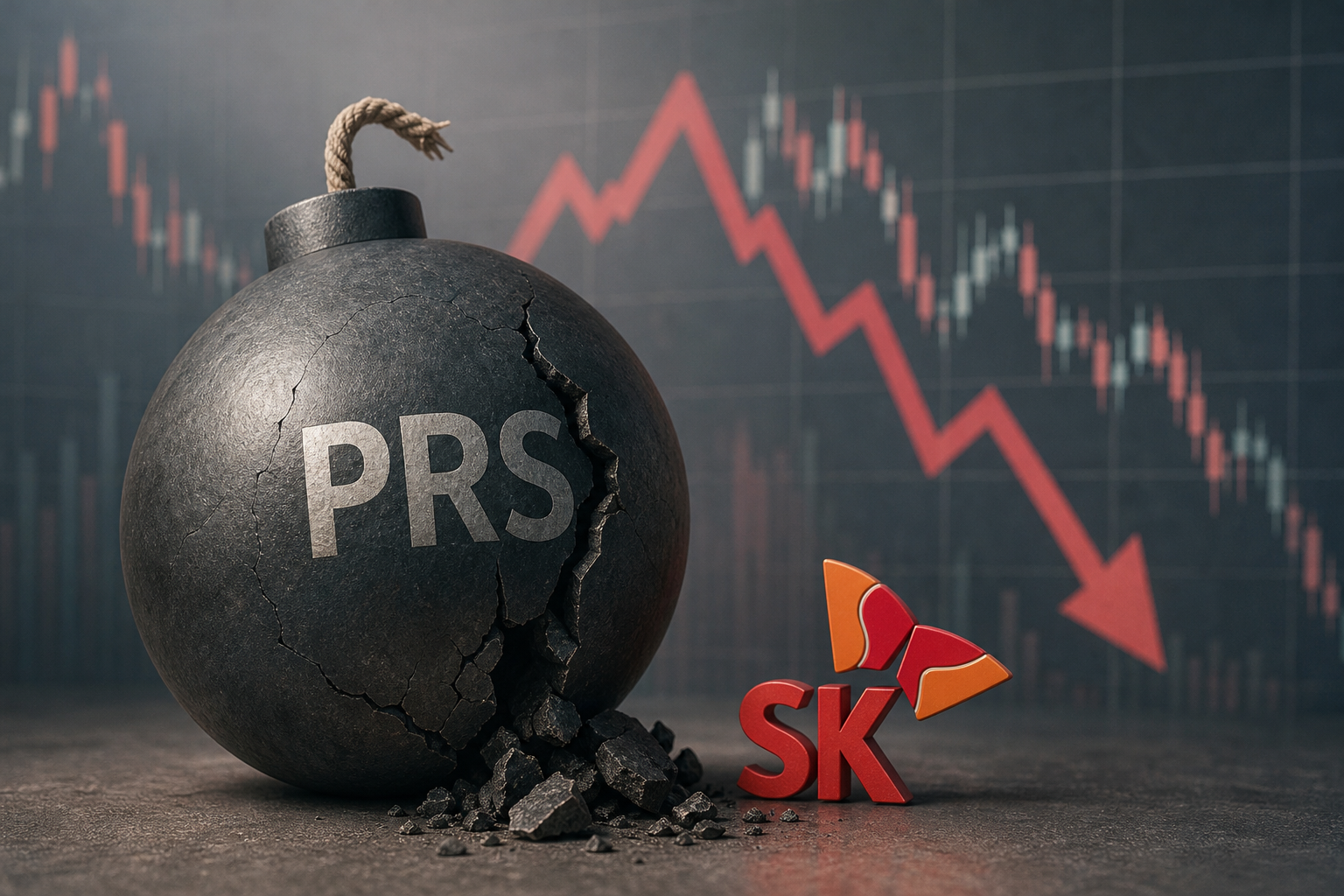
The price return swap (PRS) market, through which companies raise funds using their stock holdings, has expanded explosively over the past three years. Issuance has poured in mainly from large business groups that need massive capital, thanks to the advantage that PRS is not booked as debt on financial statements. But as stock market volatility grows, the risk of large settlement losses and cash outflows from falling share prices has emerged as a hidden financial time bomb for companies.
Korea Investors Service released an analysis report on Oct. 28 warning of related liquidity risks. According to the report, domestic contract balances, which were below 1 trillion won (about $738 million) until 2023, surged to 22 trillion won (about $16 billion) as of September 2026.
PRS is a derivative-linked transaction in which a company sells underlying shares to secure funds, while settling future gains or losses from share price movements. Legally, it takes the form of a sale that transfers equity for cash, but economically it is equivalent to borrowing money using the shares as collateral.
The rapid growth of such off-balance-sheet borrowing in a short period resulted from matching interests of demand and supply. Holding companies and large corporations can raise new investment capital without increasing their accounting debt ratios. On the other hand, brokerages that supply funds actively incorporated PRS as a new structured finance product that preserves principal and generates contracted returns, as the real estate project financing market contracted.
In fact, the funds raised were concentrated in industries requiring large-scale investment or under pressure from sluggish business conditions. By cumulative issuance, holding companies accounted for 25.1%, followed by secondary batteries (20.0%) and petrochemicals (19.4%).
By group, SK had the largest cumulative contract size at 7.3 trillion won (about $5.4 billion). It was followed by Hanwha at 3.6 trillion won (about $2.7 billion), POSCO at 2.5 trillion won (about $1.8 billion), LG at 2 trillion won (about $1.5 billion), and Lotte at 1.8 trillion won (about $1.3 billion). In particular, SK had an overwhelmingly high proportion of capital-increase-type contracts using new shares of unlisted subsidiaries such as SK On. Lotte and Hanwha had a high proportion of contracts collateralized by unlisted shares or stakes in overseas subsidiaries, which is assessed to create greater uncertainty in future valuation and disposal processes.
The biggest limitation is the potential repayment burden that does not appear on financial statements. If the share price rises, the company profits, but if it falls below the reference price, the company must pay the difference to investors in cash. With recent volatility in the Korean stock market, this risk is already materializing. In the case of SK Group, derivative liabilities related to battery and energy underlying assets soared to about 2.3 trillion won (about $1.7 billion) as of the end of June 2026 due to falling asset values.
Various trigger clauses hidden in contracts also squeeze companies' funding. If the share price or collateral value plunges, a margin call requiring immediate cash collateral is triggered. If the issuer's credit rating is downgraded or a major shareholder sells its stake, investors may exercise tag-along rights requiring their shares to be sold as well, which could cause unexpected large cash outflows for the company.
Compared with other off-balance-sheet borrowing instruments, PRS can bring stronger short-term liquidity pressure. While total return swaps (TRS) exchange total returns such as dividends and interest on underlying assets and share various market risks, this structure determines large settlement amounts solely by a single indicator: share price fluctuations. Also, unlike hybrid capital securities, which mainly pose refinancing risk for the issuer itself, PRS has a structural weakness in that business risks of subsidiaries are directly transferred to the parent company's financial burden. If a stock market shock hits while multiple affiliates have simultaneously drawn funds, the group's overall capacity to provide support will inevitably decline sharply.
A key point to watch is that financial authorities and accounting standard-setting bodies are scrutinizing the related accounting treatment. There is a growing authoritative interpretation that the transaction should be classified as 'borrowing' rather than 'sale' by considering substantive control over price risk rather than the legal form of the transaction.
If all existing contract balances are reclassified as actual borrowings, debt ratios of major issuers are expected to surge and indicators of interest payment capacity to deteriorate noticeably. Ultimately, the success of large corporations' financial soundness depends on the amount of borrowings recognized due to accounting standard changes, the level of group-wide spare funds secured to defend against share price declines and respond to margin calls, and whether upcoming large contracts can be successfully extended at maturity.
(Dollar figures are approximate, converted automatically at 1,000 won = $0.738, the rate on Nov. 8, 2026.)
※ This article is an AI translation of the Korean original published by Korea Credit News; it was checked by automated quality guards and published by the English edition desk.