
- Published 2026.11.06 11:29
Swiss commodity trader Mercuria charters Sinokor VLCC
Declining demurrage clause cuts risk from prolonged delays
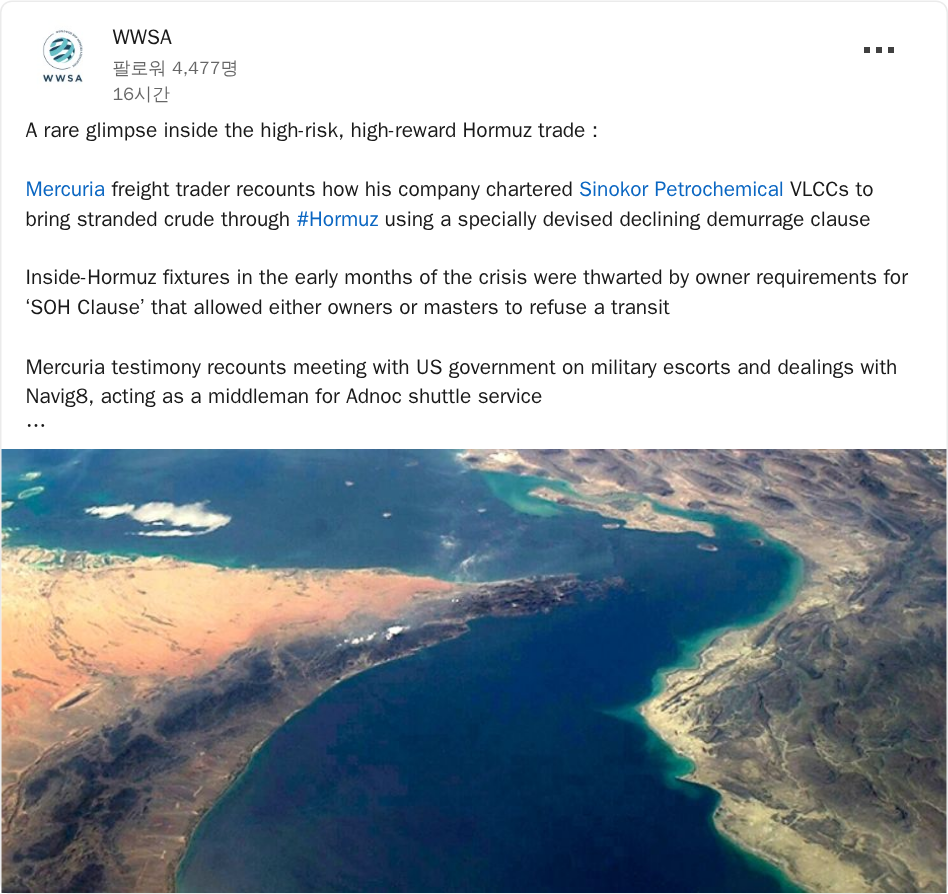
Mercuria, a Swiss global commodity trader, chartered a very large crude carrier (VLCC) from Korean shipping company Sinokor Merchant Marine to transport crude oil through the Strait of Hormuz in the Middle East. The deal is notable for including special charter terms designed to reduce the cost burden from shipping delays in the high-risk area.
According to WWSA, a shipping and logistics research firm, on Nov. 6, a cargo trader at Mercuria recently chartered a VLCC from Sinokor Petrochemical to move crude oil stuck at the Strait of Hormuz. The trader said he used a specially designed declining demurrage clause in the process. WWSA disclosed the details on its official LinkedIn account on Nov. 5.
The Strait of Hormuz is a critical chokepoint through which about 20% of the world's seaborne crude oil passes. Whenever geopolitical tensions rise, risks such as vessel seizures, hijackings and navigation restrictions emerge, making it a route that can offer high returns but carries equally high risk. If a ship cannot pass through the strait and has to wait, or if unloading is delayed, the demurrage that the charterer must pay to the shipowner can rise sharply. As geopolitical instability in the Middle East has deepened recently, delays in the sailing schedules of ships passing through the strait have become more frequent.
The declining demurrage clause that Mercuria agreed with Sinokor is a special contract designed so that the daily demurrage rate gradually decreases as the delay period lengthens. Under a standard charter contract, a fixed demurrage rate is charged in proportion to the number of waiting days, but with this clause the charterer's financial burden can be limited even if a force majeure long-term wait occurs. It reflects how global traders manage shipping risk in preparation for geopolitical uncertainty.
The Sinokor VLCC deployed for this shipment can carry about 2 million barrels of crude oil at a time. The daily charter rate for a VLCC reaches tens of thousands of dollars depending on market conditions, and if such a capital-intensive vessel is tied up for a long period, demurrage can erode the profitability of the entire cargo shipment. Mercuria and Sinokor applied modified terms instead of a standard contract to share this cost risk.
While many global shipping lines are rerouting around the Cape of Good Hope in Africa to avoid Middle East risk, Sinokor put its ship into Hormuz crude transport under a special contract. The shipowner and charterer structured the deal in a way that exchanges risk and return.
As geopolitical tensions in the Strait of Hormuz continue, special contract cases to manage cargo transport risk are emerging one after another. With Sinokor's tanker now carrying crude through the Strait of Hormuz, the contract structures between shipping lines and traders on high-risk routes are drawing fresh attention.
※ This article is an AI translation of the Korean original published by Korea Credit News; it was checked by automated quality guards and published by the English edition desk.