
- Published 2026.11.05 08:56
US Commerce Department publishes final results of 2024 annual review of Korean carbon steel plate
Hyundai Steel up 0.08 percentage point from prior year, Dongkuk Steel down 0.32 percentage point
Policy of treating cheap electricity as subsidy maintained; impact limited due to low share of US exports
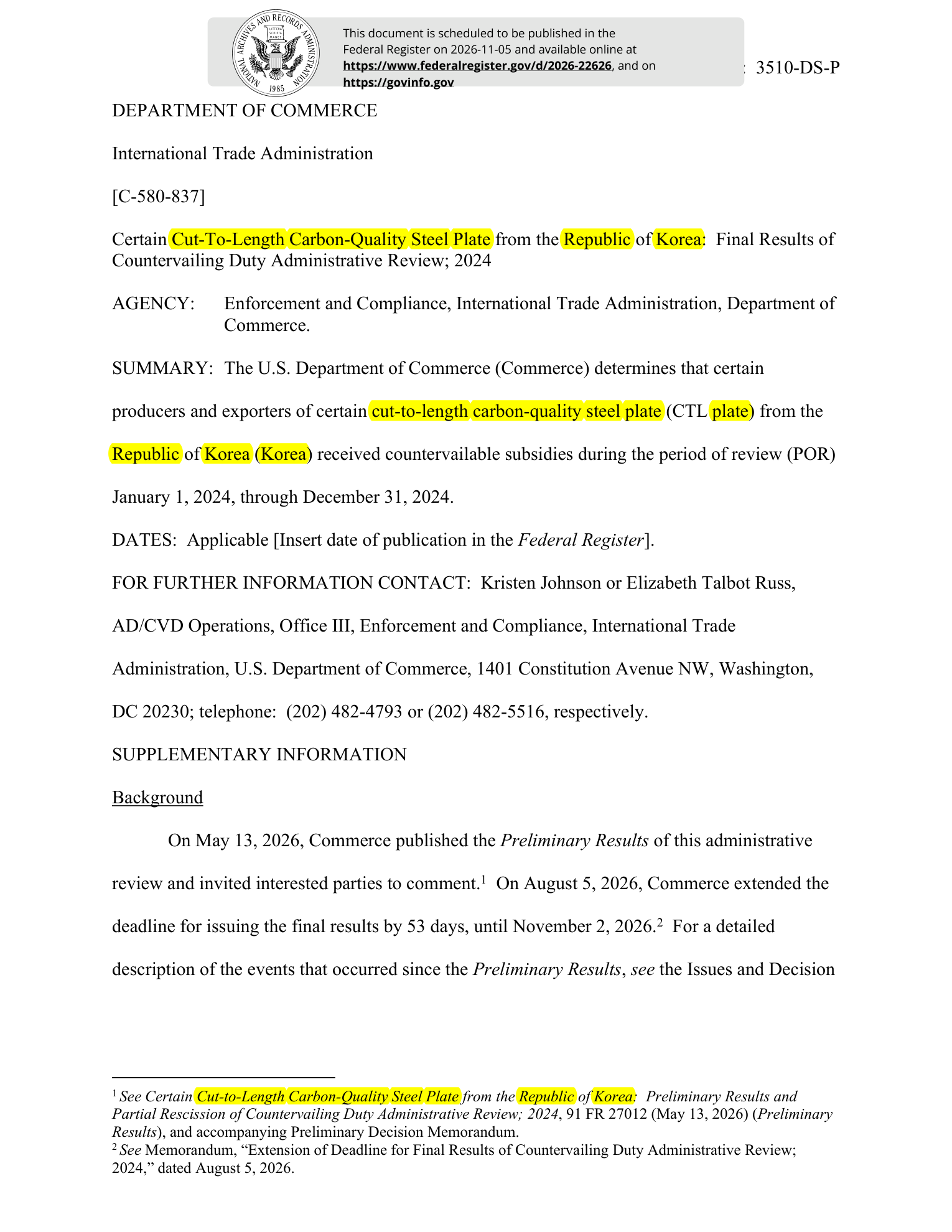
The U.S. Commerce Department has finalized countervailing duty (CVD) rates of 1.39% on Hyundai Steel and 1.89% on Dongkuk Steel in its annual review of Korean cut-to-length carbon-quality steel plate. The U.S. trade stance of treating Korea's low industrial electricity rates as a government subsidy continues, affecting the U.S. export environment for major Korean steelmakers.
According to the U.S. Federal Register on Nov. 5 (Korea time), the Commerce Department published the final results of its CVD annual review of Korean carbon steel plate imports for 2024 (Jan. 1–Dec. 31). The review imposed CVD rates of 1.39% on Hyundai Steel and 1.89% on Dongkuk Steel, both producers and exporters of plate.
Countervailing duties are imposed by an importing country to offset subsidies that an exporting country's government unfairly provides to its companies. Compared with the final results of the 2023 annual review announced in February 2026 (Hyundai Steel 1.31%, Dongkuk Steel 2.21%), Hyundai Steel's rate rose slightly by 0.08 percentage point, while Dongkuk Steel's fell by 0.32 percentage point.
Compared with the 2022 review (Hyundai Steel 2.21%, Dongkuk Steel 2.01%), when both companies faced rates in the 2% range, their overall tariff burdens have eased somewhat.
The key issue in calculating the rates was Korea's electricity pricing. The Commerce Department has determined that Korea Electric Power Corp. supplies industrial electricity below cost, effectively giving the steel industry a government subsidy.
Korean steelmakers and the government filed suit at the U.S. Court of International Trade (CIT) and won a ruling that high electricity consumption alone does not mean a specific industry receives a benefit. However, the Commerce Department's subsidy determination approach was applied unchanged in this review.
Still, the impact of the finalized CVD rates on Korean steelmakers' overall earnings is limited. According to trade statistics from the Korea Iron & Steel Association, exports of heavy plate to the United States fell steadily from 239,000 tons in 2023 to 188,000 tons in 2024 and 123,000 tons in 2025.
In fact, U.S. plate exports account for only about 1–2% of total revenue at both Hyundai Steel and Dongkuk Steel. With the Federal Register publication, U.S. Customs and Border Protection (CBP) will begin liquidation procedures for imports during the review period, and new cash deposit rates based on the finalized duties will apply to Korean plate entering the United States going forward.
※ This article is an AI translation of the Korean original published by Korea Credit News; it was checked by automated quality guards and published by the English edition desk.