

- Published 2026.09.18 12:14
Learning cell movement with 4D microscopy
Expected to aid development of treatments for cancer, Alzheimer's
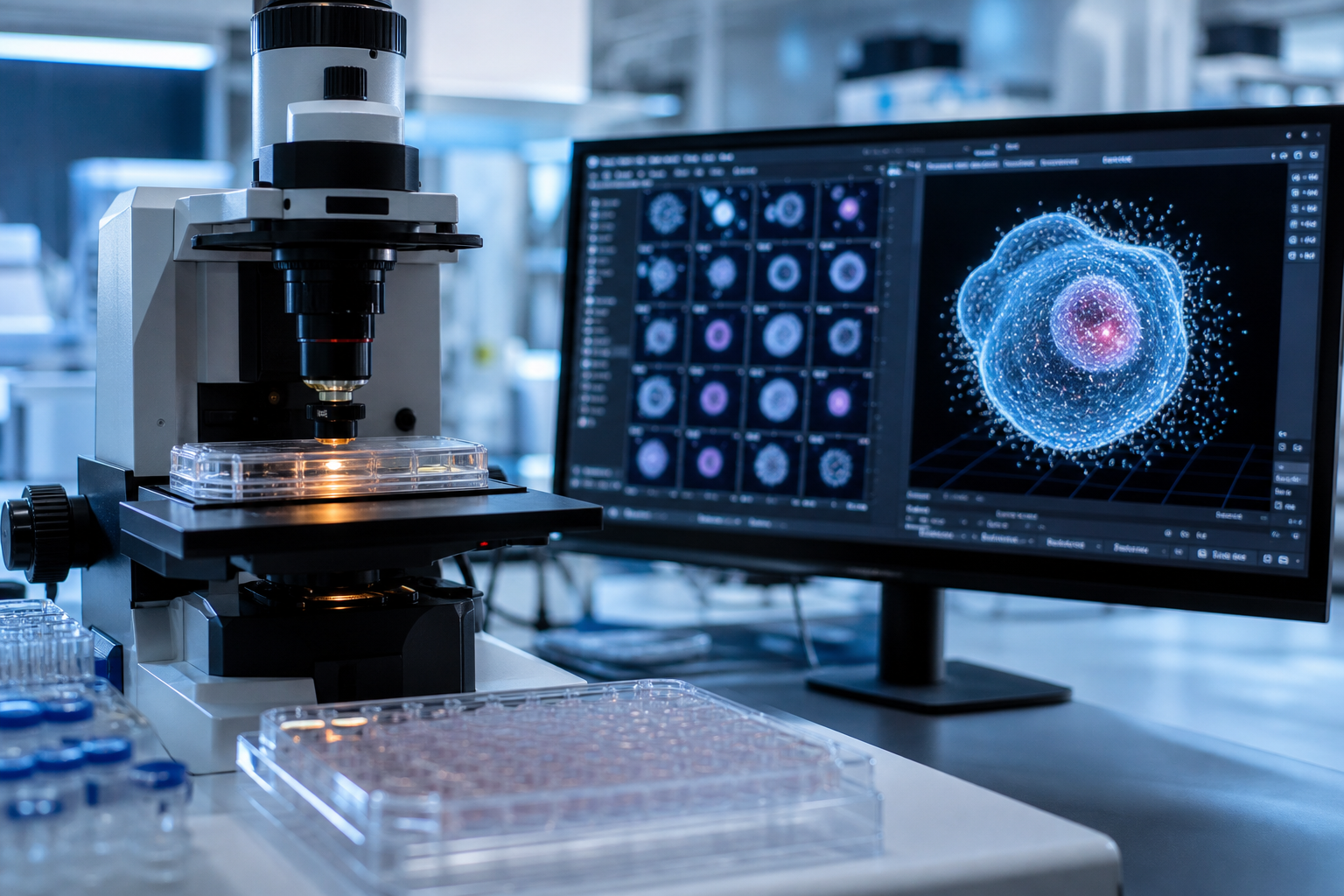
Technology has been developed to speed up drug development using virtual cells built with four-dimensional (4D) artificial intelligence (AI) models and digital twins.
On Sept. 17 (local time), a research team at the University of California, San Diego (UC San Diego) published two papers on the findings in the international journal Cell.
Mitochondria, which supply energy to cells, change shape depending on cell health and can be used as disease indicators or for drug testing. However, existing methods observed mitochondria only as flat, static images, making it difficult to understand functional changes.
The research team created virtual cells using 4D lattice light-sheet microscopy. This technology captures how structures inside cells, such as mitochondria, move in three dimensions over time.
The first approach used MitoSpace, a deep-learning AI model. The team trained the AI on 40,000 4D videos of drug-treated cancer cells.
The AI predicted the energy state of cells based solely on mitochondrial shape and movement, and distinguished drug types with 75% accuracy. This is higher than the 56% accuracy achieved using existing 2D images.
The second approach builds a digital twin of a living cell. The team defined behavioral rules for cell organelles and applied them to a physics-based model. This virtual cell reproduced the mitochondrial response of real cells to specific drugs almost identically.
Corresponding author Professor Johannes Schöneberg said, "Cells are four-dimensional objects that have depth and never stop moving," adding, "Virtual cells must be built on data that captures that fact."
The team expects the technology to accelerate drug development for various diseases, including cancer, diabetes, and Alzheimer's disease.
The team's next goal is to combine the AI model and digital twin to create a complete virtual human cell. Ultimately, they aim to model entire tissues made of multiple cells to inform clinical treatment.
※ This article is an AI translation of the Korean original published by Korea Credit News; it was checked by automated quality guards and published by the English edition desk.