

- Published 2026.11.09 23:34
Indonesian government begins sanctions against 11 companies suspected of causing forest fires
Full revocation for 3 firms with over 50% burned area; Korean stakes included
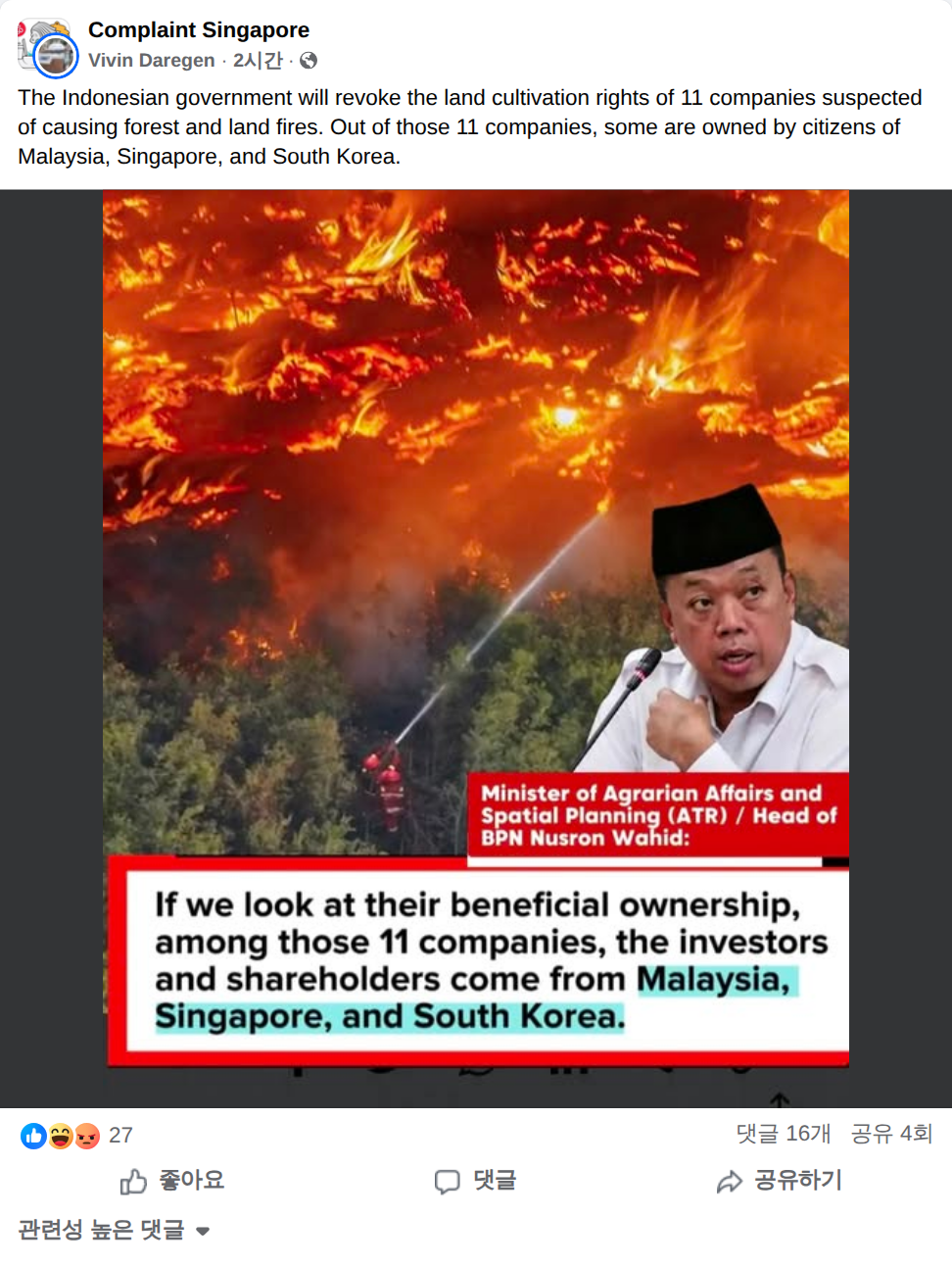
The Indonesian government is moving to revoke the cultivation rights (HGU) of 11 plantation companies suspected of causing large-scale forest fires. The move signals a tough response to reckless land management by companies that have been identified as the root cause of forest fires, which lead to severe environmental destruction and transboundary haze affecting neighboring countries.
According to Indonesia's Ministry of Agrarian Affairs and Spatial Planning/National Land Agency (ATR/BPN) on Nov. 9, the government has accepted the recommendation of the National Police's Criminal Investigation Agency (Bareskrim) and begun procedures to revoke or suspend the cultivation rights of 11 companies in Kalimantan. Minister Nusron Wahid said at a press conference on forest utilization business permit evaluation, "The beneficial owners of these 11 companies include not only Indonesian nationals but also investors from Korea, Malaysia, and Singapore."
The Indonesian government has divided the companies into several groups based on the extent of fire damage and recurrence, determining the level of sanctions. For three companies where more than 50% of their concession area was burned or where fires occurred repeatedly, the government decided to fully revoke their cultivation rights. The targets are PT MIB (4,000 hectares) in South Kalimantan, PT RKA (11,558 hectares) and PT SKM (7,715 hectares) in West Kalimantan. These companies were found to lack even proper fire prevention and suppression facilities.
For three companies that were about to receive cultivation rights, the government decided to completely halt the issuance of final rights. These are PT ANI (5,244 hectares) in West Kalimantan, PT BOS (4,750 hectares) in Kapuas Hulu, and PT AEL (5,134 hectares). PT SAE, whose burned area was less than 50%, received a partial revocation for 1,510 hectares. The remaining companies either had their cultivation rights expire in 2020 or are currently under review for specific sanctions.
In Indonesia, the practice of deliberately setting fires or clearing land by burning to secure oil palm plantations and timber plantations for pulp and paper leads to large-scale forest fires every year. Especially during the dry season, fires spread to peatlands, generating massive amounts of greenhouse gases and toxic smoke, causing serious diplomatic friction with neighboring countries. According to data compiled by Indonesian environmental group WALHI, 75,621 fire hotspots were detected in 37 provinces nationwide in just two months from September to October 2026. As of September this year, the total area affected by forest fires reached 1,912,926 hectares.
In particular, WALHI's spatial analysis showed that a significant number of fire hotspots were concentrated in 945 plantation cultivation rights areas and 353 forest business permit areas owned by companies. As companies' land management, which is obligated to prevent fires, has been identified as a major cause of large-scale forest fires, Indonesian authorities are further strengthening administrative sanctions for neglecting forest fires within permit areas.
※ This article is an AI translation of the Korean original published by Korea Credit News; it was checked by automated quality guards and published by the English edition desk.