
- Published 2026.11.10 05:59
Withdrawal confirmed in U.S. Federal Register notice of membership changes on Nov. 10
Move seen as building independent path in autonomous driving and infotainment network market
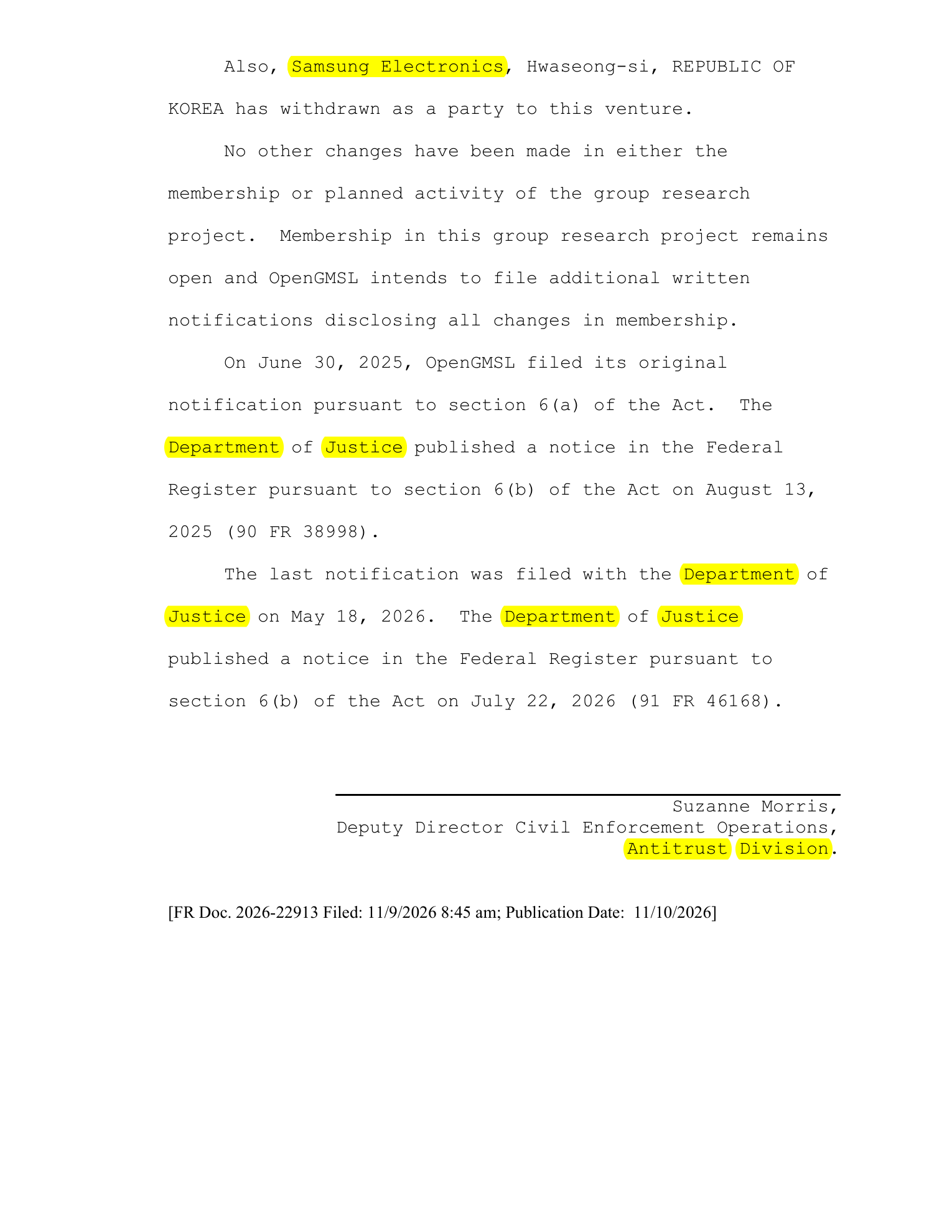
Samsung Electronics has officially withdrawn from the research and development project of the OpenGMSL Alliance, an ultra-high-speed automotive connectivity standards body led by U.S.-based Analog Devices (ADI). The move signals a strategic shift by Samsung Electronics, which is strengthening its position in automotive semiconductors and image sensors, in the competition over communication interface standards.
According to the U.S. Federal Register on Nov. 10, the OpenGMSL Alliance said in a membership change notice filed with the U.S. Department of Justice and the Federal Trade Commission (FTC) that Samsung Electronics has withdrawn from the alliance's R&D project. The notice, submitted to obtain antitrust immunity, listed Samsung Electronics' withdrawal along with the new membership of nine companies including Taiwan's Realtek and ASMedia, and China's Horizon Robotics.
The OpenGMSL Alliance was launched in June 2025 by global semiconductor company ADI to convert its proprietary GMSL (Gigabit Multimedia Serial Link) technology into an open standard. GMSL is an ultra-high-speed serializer-deserializer (SerDes) technology that transmits large volumes of video and sensor data from in-vehicle cameras, radar and displays without latency. According to ADI, more than 1 billion GMSL semiconductors are currently installed in vehicles from over 25 global automakers and about 50 component suppliers.
The automotive ultra-high-speed connectivity market is shifting from proprietary technologies to open, universal standards. While Ethernet has become the default backbone network in vehicles, SerDes technology is essential for asymmetric, latency-sensitive, high-bandwidth data transmission such as cameras and displays. In the automotive SerDes market, multiple standards are competing for share, including A-PHY led by the MIPI Alliance and ASA Motion Link from the Automotive SerDes Alliance (ASA), in addition to OpenGMSL.
Samsung Electronics supplies automotive infotainment processors such as Exynos Auto and automotive image sensors such as ISOCELL Auto to global automakers. As autonomous driving and advanced driver assistance systems (ADAS) advance, processing of high-resolution sensor data is increasing, making ultra-high-speed connectivity essential infrastructure for automotive semiconductor components. Samsung Electronics has been a key member of other universal standardization bodies such as the MIPI Alliance and ASA, supporting various communication standards in its chipsets. Through this, the company is focusing on an open interface ecosystem with versatility and scalability, without being tied to a specific technology.
Despite Samsung Electronics' withdrawal, the OpenGMSL Alliance continues to expand its ecosystem. The notice announced the addition of global automotive and semiconductor companies including a Mercedes-Benz subsidiary, indie Semiconductor, GalaxyCore Shanghai, and ASMedia. As the number of in-vehicle displays and sensors rises sharply, competition among global companies to secure communication standards continues.
※ This article is an AI translation of the Korean original published by Korea Credit News; it was checked by automated quality guards and published by the English edition desk.