
- Published 2026.10.04 11:06
Fund valuation evaporates 9.7% in one month as stocks plunge in July
Criticism over delayed rebalancing grows, countered by defense of returns
Fund independence and governance overhaul become key issues at parliamentary audit
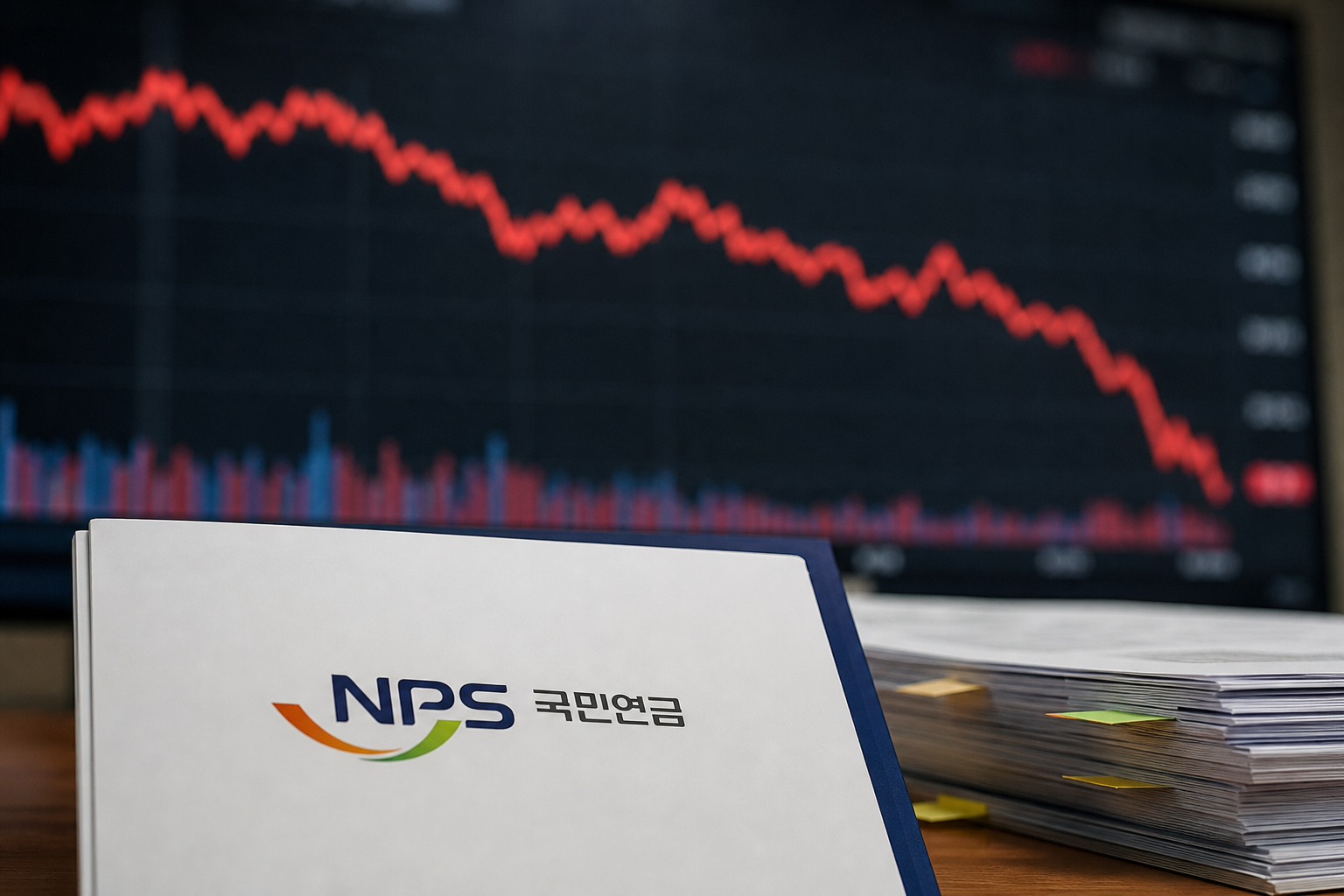
The National Pension Service (NPS), which manages retirement funds for Korean citizens, posted valuation losses of more than 181 trillion won (about $134 billion) in just one month amid the domestic and global financial market crash in July 2026. The decision to temporarily defer asset rebalancing and increase its Korean stock allocation during the first-half stock market boom appears to have backfired, absorbing the full shock of the downturn. Ahead of the parliamentary audit, criticism that the fund was used as a tool for the government's aggressive stock market support policies is clashing with the counterargument that the move was a strategic choice to defend returns.
According to portfolio data by asset class disclosed by the NPS Investment Management Division and statistics submitted to the National Assembly, the NPS fund's reserves stood at 1,684.173 trillion won (about $1243 billion) as of the end of July. Compared with the all-time high of 1,865.576 trillion won (about $1377 billion) at the end of June, 181.403 trillion won (about $134 billion), or 9.7%, evaporated in a single month.
The core source of the losses was Korean stocks. The NPS's Korean stock valuation fell to 418.558 trillion won (about $309 billion) at the end of July from 543.204 trillion won (about $401 billion) at the end of June, a decline of 124.646 trillion won (about $92 billion). The cumulative return on Korean stocks, which had surged to 107.37% since the beginning of the year, also dropped by more than 47 percentage points to 60.11% at the end of July. This was largely due to the KOSPI plunging more than 22% from around the 8,470 level at the end of June to around 6,590 at the end of July. Overseas stocks also decreased by about 37 trillion won (about $27 billion) from the 661 trillion won range to the 624 trillion won range amid concerns over the sustainability of artificial intelligence (AI) investment in major countries and a correction in technology stocks. The fund's overall cumulative return was halved to 14.84% at the end of July from 27.22% at the end of June.
Market watchers point out that the valuation losses stemmed from structural causes beyond a simple macroeconomic downturn. The NPS Fund Management Committee under the Ministry of Health and Welfare temporarily suspended rebalancing for six months in January 2026, saying it would prevent mechanical selling of Korean stocks. At the end of May, it sharply raised the target allocation for Korean stocks this year to 20.8% from 14.9%. It also allowed the fund to hold up to 28.8% in Korean stocks by adding the permissible ranges for strategic asset allocation (SAA) and tactical asset allocation (TAA), and the actual holding ratio rose to 29.1% at the end of June.
In the financial investment industry, analysts say that if the fund had sold stocks in tranches at highs and secured cash according to its principles, it could have defended against the July downturn and used it as an opportunity to buy low, easing volatility. By facing the crash without reducing risk exposure, the valuation losses ballooned uncontrollably to the 180 trillion won range, they say.
The unprecedented evaporation of fund assets has intensified external pressure and a blame game. Labor and civic groups strongly criticized the move, saying that expanding the allocation even at the cost of breaking the asset allocation principles the NPS had established was a dangerous attempt to use the pension fund as a tool for the administration's stock market support policies.
Opposition lawmakers on the National Assembly's Special Committee on Pension Reform and the Finance and Economy Planning Committee raised responsibility claims against the National Pension Service, saying the government's decision ignored the long-standing policy of reducing Korean stock holdings to prevent macroeconomic distortions and caused enormous losses to citizens' retirement funds. In particular, they are focusing on suspicions that the fund's volatility exposure has deepened due to the expansion of high-risk derivative products, including the introduction of single-stock leveraged exchange-traded funds (ETFs).
Meanwhile, the Ministry of Health and Welfare, the ministry in charge, and the Fund Management Committee are not backing down, saying the decision was a strategic choice that took market conditions into account. Health and Welfare Minister Jeong Eun-kyeong drew a firm line at a National Assembly meeting, saying, "There are limits to explaining stock price volatility solely through rebalancing," and that she does not regret the deferral decision.
Minister Jeong explained that if the fund had stuck to the existing target of 14.9%, it would have poured cold water on the first-half domestic stock market rally and failed to enjoy the explosive returns. She also cited the fact that despite the July plunge, the fund's overall return since the beginning of the year remains solid at 14.84%.
Financial market experts are paying attention to the deepening distortions in the Korean financial market and the systemic risk the NPS will have to bear going forward. This is because the NPS, which has grown into one of the world's three largest pension funds, could have enormous side effects on the market if it arbitrarily adjusts the permissible asset allocation ranges.
Lee Kyu-hong, head of the NPS Investment Management Division and chief investment officer (CIO), who took office in mid-September, has been saddled with the heavy burden of overhauling the damaged portfolio. His first test will be how to achieve a soft landing for the Korean stock allocation, which has already far exceeded its target, without shocking the domestic stock market during the future rebalancing process.
The incident has emerged as a key issue at the upcoming regular National Assembly audit. The audit is expected to focus on whether to disclose key minutes of the Fund Management Committee, suspicions of compromised independence during the rebalancing deferral process, and ways to institutionalize an independent governance structure to buffer market volatility. With global uncertainty continuing, a full-scale overhaul of the risk management system for the fund, which has fallen to the 1,680 trillion won range, has become inevitable.
(Dollar figures are approximate, converted automatically at 1,000 won = $0.738, the rate on Nov. 9, 2026.)
※ This article is an AI translation of the Korean original published by Korea Credit News; it was checked by automated quality guards and published by the English edition desk.